Pasture and Silage Quality Testing: Turning Grass into Better Decisions
For many New Zealand farmers, pasture is the largest component of the feed budget. Measuring pasture and silage quality is key to getting the most out of home-grown feed. While a paddock may look green and lush, its nutritional value can vary considerably depending on season, pasture species, maturity and soil conditions.
Pasture and silage quality testing provides farmers with data on what animals are actually eating, rather than relying on visual assessment alone. This supports better feed allocation, supplementation decisions, animal performance and overall farm profitability. Testing during spring can also provide an early warning system, enabling farmers to make proactive feed management decisions before production has already been lost.
Testing pasture and silage quality gives farmers a practical way to match feed supply with animal requirements, identify seasonal risks early, and make better-informed decisions about supplementation, silage use and mineral management.
Looks can be deceiving
High pasture covers do not necessarily mean high-quality pasture. As pasture matures, fibre levels increase, while digestibility and metabolisable energy decline. This means animals may need to consume more dry matter to achieve the same energy intake, which can limit performance when intake is constrained. Protein, soluble sugars and starch can also fluctuate throughout the season.
Laboratory analysis provides measurements such as ash, crude protein, dry matter, digestible organic dry matter, metabolisable energy, neutral detergent fibre and starch. Together, these measures indicate how much usable feed is available, how digestible it is, and how efficiently livestock can convert pasture into meat, milk or wool.
Animal requirements differ by age and production stage, with lactating dairy cows, ewes with lambs at foot, finishing stock and growing stock all having different energy, protein and mineral requirements. The same pasture or silage quality results can lead to different management decisions depending on the livestock class being fed.
Managing seasonal feed quality
The nutritional value of pasture changes rapidly in spring. Feeding decisions made during this time have a large impact on animal performance and profitability for the rest of the season.
Additionally, animals often have their highest nutrient and energy requirements at this time of year, driven by peak lactation in dairy cows or lambing and calving in red meat operations. Young stock are also rapidly growing. Together, this means nutritional and energy deficits can have long-lasting impacts on production and reproduction, including reduced milk solids, slower liveweight gain, poorer body condition and in some cases, lower in-calf rates the following season.
The following graphs show the variation of metabolisable energy in mixed pasture and baleage silage, and maize silage, using results from the past three seasons combined (Figures 1 and 2). Results can vary between 6 and 13 MJ/kgDM for mixed pasture silage and baleage and 8.5 and 12 MJ/kgDM for maize silage.
Because we receive information on when samples are submitted rather than when the silage was made, these results should be interpreted as submitted sample trends rather than exact harvest date trends.
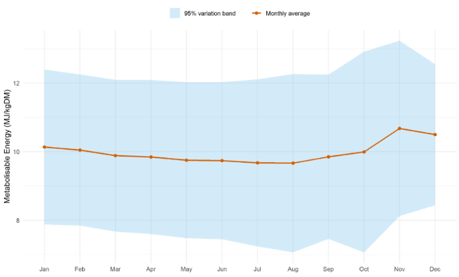
Figure 1. Monthly averages of national mixed pasture silage and baleage results pooled across the past ten years, with variability represented by the upper and lower ranges (blue).
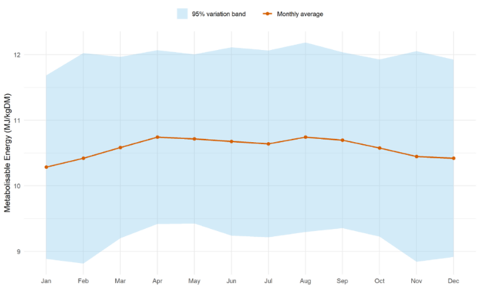
Figure 2. Monthly averages of national maize silage results pooled across the past ten years, with variability represented by the upper and lower ranges (blue).
Variation in pasture metabolisable energy ranges from 8 to 14 MJ/kgDM across the season, demonstrating the need for ongoing monitoring and adaptive feed management to maintain animal performance (Figure 3).
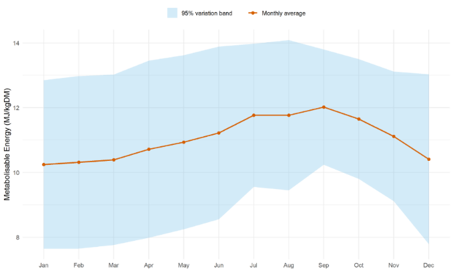
Figure 3. Monthly averages of national mixed pasture results pooled across the past ten years, with variability represented by the upper and lower ranges (blue).
The wide ranges shown in these results reflect differences in pasture species, maturity at harvest or grazing, conservation conditions, weather, soil fertility and sample timing. This is why individual farm testing remains important even when regional averages are available.
It is important to note that results are only as useful as the sample submitted. Representative pasture or silage samples, taken from the feed animals are actually consuming and handled to minimise moisture loss or contamination give the most reliable results for decision making.
Small investment, significant returns
Pasture is one of the most valuable assets on a New Zealand farm. Pasture and silage quality testing complements the question “do I have enough grass” with “do I have enough of the right quality grass to meet my animal’s nutritional needs”. Measuring to manage is key to getting the most out of pastures and silage. Test results may indicate a need to adjust grazing management, supplement with higher-quality feed, or review silage allocation for high priority stock.
The Pasture Feed Quality Profile is designed for monitoring pasture quality across the season.
Additionally, mineral testing of pasture provides an early indication of possible mineral deficiencies and an opportunity to manage them proactively. These results tie in with our Animal Dietary Mineral Balance (ADMB) report, comparing measured pasture mineral levels against the nutritional requirements of specific livestock classes. This helps assess risks associated with disorders such as grass staggers, milk fever and bloat.