The Expertise Behind Reliable Residue Testing
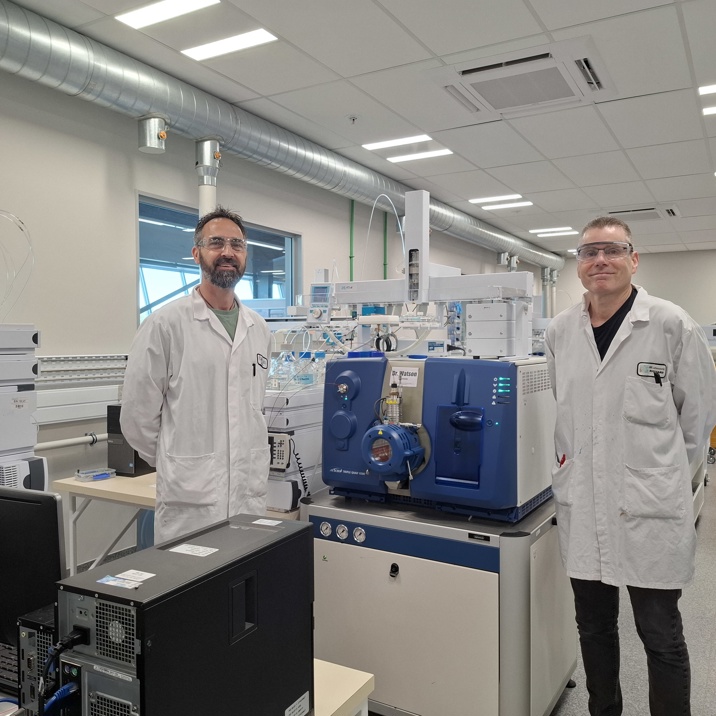
Pictured: Jared Loader, left, and Richard Schriner
From orchard and field to packhouse and export market, pesticide residue testing provides confidence throughout the food supply chain. Hill Labs' residues testing service supports growers, producers, exporters and industry organisations with analysis of more than 600 pesticide residues across a broad range of food and environmental samples.
Backed by advanced technology and extensive technical expertise, the service delivers trusted, IANZ-accredited results across both routine and complex testing requirements. But behind every result is a team of scientists whose knowledge, innovation and attention to detail help ensure testing remains accurate, reliable and fit for purpose with results received by the customer on time.
Meet three of the experts whose knowledge and experience support the delivery of Hill Labs' pesticide residue testing service.
Richard Schriner, Senior Technologist
With decades of experience in analytical chemistry and residue testing, Richard plays a key role in ensuring Hill Labs' residue testing methods remain accurate, reliable and fit for purpose. Drawing on extensive experience across a wide range of sample types, he is involved in developing robust methods that stand up to real-world testing challenges, while evaluating new technologies and innovations that could further strengthen testing capabilities.
Providing accurate and reliable residue testing is about more than instrumentation and methodology, Richard says. Over the course of his career, he has seen analytical technology become increasingly sophisticated, but believes the fundamentals remain the same. Understanding the chemistry, anticipating potential challenges, and applying practical experience to a diverse range of sample types are all critical to producing reliable results. The real challenge, he says, is adapting those fundamentals to the unique characteristics of every sample that comes through the laboratory.
"At its core, residue testing is based on the same chemistry principles we learned early in our careers. The challenge is that every sample is different. In many ways, residue testing is like a box of chocolates. You never know what you're going to get next," says Richard.
Shaun Clay, Senior Technologist
Shaun has played a significant role in the evolution of Hill Labs' residue testing capabilities during more than three decades with the business. After joining Hill Labs in 1993, he helped establish the laboratory's food pesticide residue testing service in 1998 and has since held a wide range of technical and leadership positions, including Laboratory Technician, Team Leader, Section Manager, GLP Study Director and Technologist.
Today, Shaun manages non-routine residue testing projects across food and crop samples and serves as a report signatory for Residues, Honey and Drug Testing. Drawing on more than 30 years of experience, he works closely with clients to navigate complex testing requirements and identify the most appropriate testing approach for each project.
Shaun says one of the key challenges in residue testing is that no two projects are exactly alike. Different compounds, sample types and client requirements can all influence the most appropriate testing approach, making scientific expertise and practical experience essential.
"Testing doesn't screen for every compound at once. Different test methods may be needed to analyse different types of pesticides, and some compounds produce breakdown products that can't be detected through a standard multi-residue screen because of their chemical properties. Selecting the right testing approach is an important part of delivering reliable results," says Shaun.
Through his career, Shaun has seen significant advances in technology and testing capability. In his view, delivering reliable results relies not only on keeping pace with these developments, but also on the knowledge and experience of laboratory staff and a strong focus on understanding and responding to client needs. Together, these factors help ensure testing remains accurate, reliable and fit for purpose.
Jared Loader, Team Leader - Analytical Technology
With a PhD in Chemistry and more than 15 years at Hill Labs, including eight years specialising in pesticide residues, Jared brings extensive scientific expertise to the development and continuous improvement of residue testing methods. His experience extends beyond New Zealand, having worked with the FDA in the United States and completed research internships in Norway and Canada.
As part of his role, Jared oversees the development and implementation of new testing methods, ensures existing methods continue to perform reliably, and evaluates emerging technologies and scientific advances that could further strengthen Hill Labs' testing capabilities.
Having worked with advanced analytical instrumentation throughout his career, Jared knows firsthand how residue testing has evolved. Detecting residues at the trace levels required for food safety, often down to parts per billion, depends on sophisticated laboratory technology. With that, accurate residue testing also comes down to the people behind it.
"It comes down to experience and attention to detail. We're committed to ensuring every result we deliver is as accurate and precise as possible, and most importantly, fit for our clients' needs," says Jared.